Showing posts with label Glasgow 2014. Show all posts

Tuesday, 29 July 2014

Flying the flag for LGBT Rights

So the Commonwealth Games are in full swing, and so is our rainbow flag campaign. Here are some pictures of unions flying rainbow flags in solidarity with LGBT people around the Commonwealth.

Rainbow flags outside the EIS

Rainbow flags in the window of the NUJ and Equity offices

A rainbow flag in the window of the Musician's Union

A rainbow flag fluttering on the GMB office

A rainbow flag on the UCU building

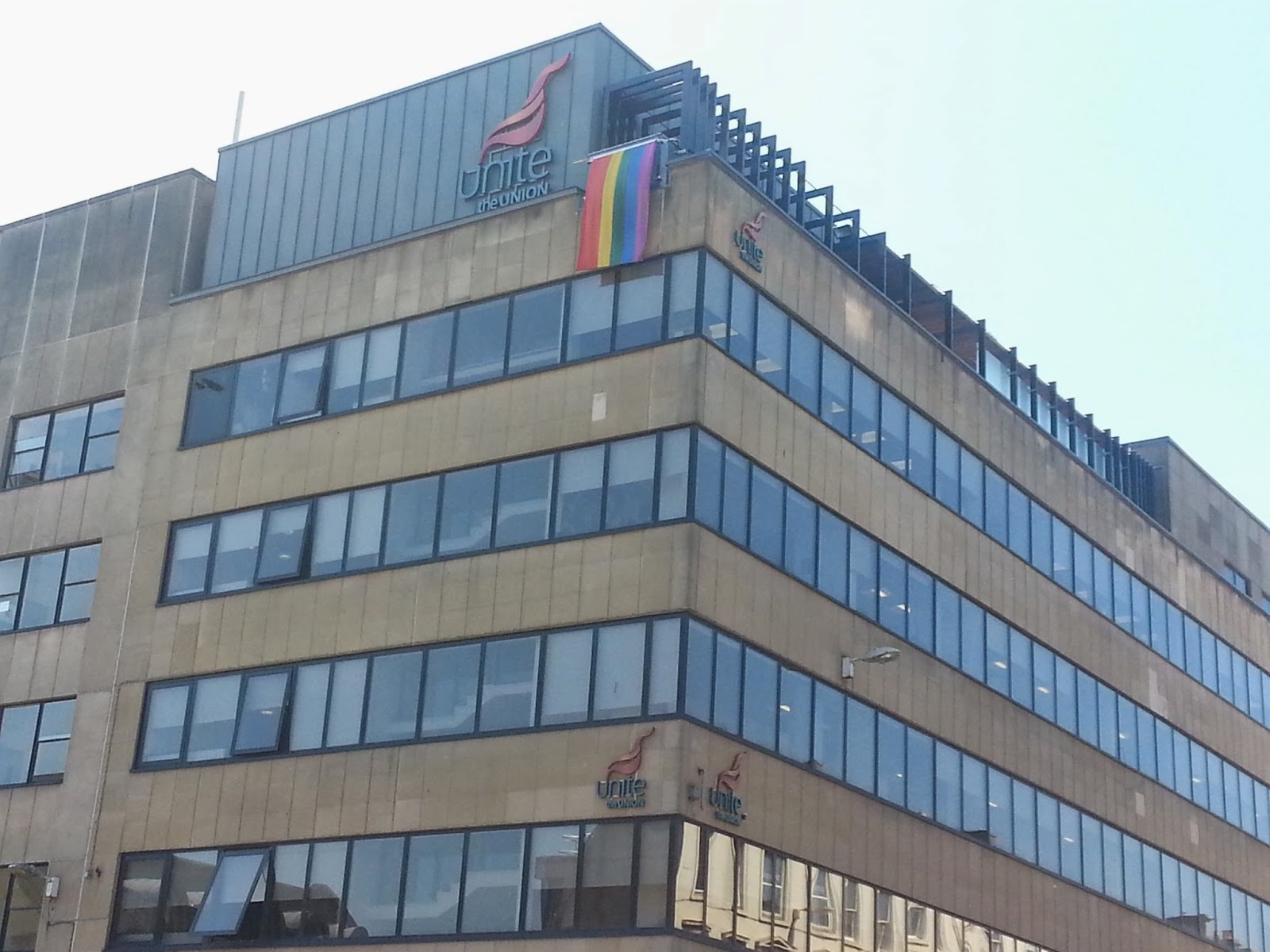
Unite flying the rainbow flag

Wednesday, 23 July 2014

Flying the Flag for LGBT Rights!


Today’s the day. The opening ceremony is in just a few hours and Glasgow is buzzing and melting! What a great combination. To top it all off here are some pictures of rainbow flags to brighten up your day.

The STUC is pleased that the response to our campaign to fly the rainbow flag has been so successful. Trade Union buildings across Glasgow and all over Scotland will be flying the flag.
The Rainbow Flag on the STUC building 

A number of Councils have also joined us including Dumfries and Galloway, East Ayrshire, West Dunbartonshire and West Lothian. Glasgow City Council, as host city, is required to work within strict protocols around the flying of flags during the Commonwealth Games. It did, however, fly the rainbow flag from the City Chambers on 11 July as a symbol of solidarity with the LGBT community in Glasgow and across the Commonwealth.

The STUC was also pleased that the Scottish Government agreed to join our campaign and fly the rainbow flag on St Andrew’s House for the duration of the Games. This is the first time that the rainbow flag has officially flown on a Scottish Government building.
The Rainbow Flag on St Andrew's House

By flying the rainbow flag during the Games we aim to show solidarity with LGBT people all over the Commonwealth. Currently 42 out of 53 Commonwealth countries criminalise homosexuality resulting in LGBT people being subject to harassment, degrading treatment and even imprisonment or death. This is simply unacceptable and it is right that we should use our Commonwealth Games to raise awareness and promote a more positive vision of the future.

Join our campaign by posting pictures during the Commonwealth Games using the hashtag  #gamespride

Helen Martin
STUC

Thursday, 10 July 2014

Why the Commonwealth needs to listen to its LGBTI citizens


Below is a guest blog from the Kaleidoscope Trust. The Kaleidoscope Trust is a UK based charity working to uphold the human rights of lesbian, gay, bisexual and trans people internationally. 

The Commonwealth Games is one of the world’s largest and greatest sporting events, bringing together athletes from every corner of the world. From Africa to Asia, the Pacific to the Caribbean, the Commonwealth’s 2 billion people make up 30% of the world’s population and are of many faiths, races, languages, cultures and traditions. The Games themselves are an amazing celebration of the diversity of the Commonwealth – an organisation that refers to itself as a family, held together by the shared values of democracy, human rights and the rule of law.

In that light it is shocking that of the 53 member nations of the Commonwealth family, 42 continue to criminalise consensual same-sex activities between adults. More than ninety per cent of Commonwealth citizens live in a country that criminalises homosexuality. Over half the countries in the world that have laws banning homosexuality are in the Commonwealth. Across the Commonwealth lesbian, gay, bisexual, trans and intersex (LGBTI) people are denied equal access to rights, education, employment, housing and healthcare.

Sadly, despite the fact that there are LGBTI people and organisations in every Commonwealth country, our existence is often denied, our rights are violated and we are treated as a foreign and alien import. The voices of LGBTI people continue to be ignored in many Commonwealth spaces – political, diplomatic, sporting and otherwise. Commonwealth leaders regularly deny that LGBTI people exist in their countries, or where they do accept our existence they paint us as immoral, disordered.

Countering this myth is what underlies a lot of the work that the Kaleidoscope Trust does.  For true equality to exist across the Commonwealth, attitudes toward LGBTI people need to be changed wherever we face social and legal discrimination. In the battle for public opinion visibility is our most powerful tool. When we are visible it becomes much harder for the opponents of equality to deny our existence. When we are seen as what we are – sons and daughters, siblings and parents, workers and bosses, friends and neighbours – it becomes much harder to paint us as immoral, threatening and foreign.

That’s why we’ve been working with the Equality Network and Pride Glasgow to ensure that when the Commonwealth Games is celebrating its amazing diversity, LGBTI people are not forgotten. We are working with LGBTI people from all over the Commonwealth to make sure our voices are heard – at the LGBTI Human Rights Conference, the Pride House, Glasgow Pride and other events. Through raising our voices together we can counter the narrative that being gay, or lesbian, or bisexual or trans, or intersex is a European or an American peculiarity. Through raising awareness of the amazing work that is going on around the Commonwealth to resist invidious laws and discriminatory attitudes we can truly celebrate the diversity of LGBTI struggle, successes and lives. LGBT people are part of the incredible diversity of the Commonwealth family and we are committed to its values of democracy, human rights and the rule of law.

That’s also why the Kaleidoscope Trust is delighted to support the STUC’s call for unions, employers and the public sector to show their support for LGBTI rights in the Commonwealth by flying the rainbow flag during the Games. If visibility is our strongest weapon, the more rainbow flags, proudly flown from buildings across Glasgow and Scotland, the more visible we are. The rainbow flag is a vital tool in showing our solidarity with LGBTI communities across the Commonwealth and showing that LGBTI people are a part of the Commonwealth family.

For the time being, the voices of LGBTI people may be ignored by many of the governments and institutions of the Commonwealth, but we are not going away. Governments must heed us, must meet with us and must embrace us as full and equal members of society. Anything less will fatally tarnish the Commonwealth, render the Games’ fine commitment to inclusion for all meaningless, and call into question the apparently shared values of democracy, human rights and the rule of law.

Alistair Stewart 
Assistant Director
The Kaleidoscope Trust


Wednesday, 2 July 2014

Why unions can fly the rainbow flag but Pride House can’t


It might be somewhat geeky but in the course of organising the STUC’s campaign around flying the rainbow flag, (for more info on this read my last blog) I discovered a quirk in the law.

In the run up to the Commonwealth Games the Scottish Government passed some legislation restricting advertising in and around Games venues while the Games are being held. This legislation is for the most part reasonable and designed to prevent advertisers taking advantage of the Games and, in particular, aims to prevent ambush marketing, where companies try to associate themselves with an event and profit from it without going to the expense of actually sponsoring it.

This legislation therefore restricts displays (including flags) in specifically determined Games zones, in an effort to keep any unauthorised profiteering to a minimum.  

Within the legislation, quite rightly, there is a specific exemption for protest which means that the STUC, Trade Unions and others can fly the rainbow flag, even within restricted Games zones, without falling foul of the legislation. We are after all not aiming to profit from the Games, we are simply raising awareness of the fact that a group of people are routinely and systematically denied their Human Rights all across the Commonwealth – with 42 out of 53 Commonwealth countries criminalising homosexuality.  The legislation recognises our right to have a demonstration and to promote a campaign and therefore we can fly the rainbow flag as a symbol of protest and solidarity.  

So far so reasonable but then we get to Pride House.

When organising a rainbow flag flying campaign you very quickly run up against the question: ‘where do I get a six foot rainbow flag from anyway?’  To answer this, I turned to Leap Sport Scotland, the organisers of Pride House, naturally expecting Pride House to be adorned with giant rainbows advertising its existence to all the world. I was surprised to learn, however, that they had received instruction that no rainbow flags were to be flown on the building as it is within a restricted Games area.

Um...what?

Well you see it all comes down to the wording of the exemption around demonstrations. While protest is allowed to publicise a campaign, the exemption does not apply to activity that promotes a good or service.

Pride House is a venue that welcomes LGBT athletes, fans, and their supporters during international sporting events. Akin to the various national houses, it is a welcoming place to enjoy the event, to learn about LGBT sport and homophobia in sport, and to build relations. In this respect Pride House could be described as offering a ‘service’ to LGBT people during the games, and advertising a ‘service’ is not allowed.

So here we are in the strange situation where Trade Unions and others will be flying the flag for LGBT rights during the games but Pride House is prevented from doing the same.

This to me seems odd and out of step with the ultimate desire of the legislation – to restrict companies from profiteering and prevent ambush marketing. Given that Pride House is designed to support LGBT athletes and visitors during the Games, it seems a shame that it cannot identify itself with the internally recognised symbol of LGBT equality (after all I am sure Scotland House will fly the saltire).

The STUC, for one, hopes that this decision will be reconsidered before the start of the Games as making LGBT people visible within sport and within the Commonwealth more generally is a key aim of our campaign and also seems to be a key part of running a Pride House in the first place.

Helen Martin
STUC     

Thursday, 26 June 2014

Fly the Rainbow Flag! Solidarity for LGBT people around the Commonwealth


The Commonwealth Games are coming to Glasgow. In just 27 days we will all be sitting down to enjoy the opening ceremony and looking forward to watching what is sure to be another great sporting event.

It's right that everyone in Scotland, and Glasgow in particular, should take pride in our Games and should welcome with enthusiasm the athletes and visitors to our country, but while enjoying the occasion we should also not forget some of the issues that still exist around the Commonwealth and we should aim to project a positive image of Scottish values around the world.    

It is in this spirit that the STUC is planning to fly the rainbow flag on our buildings throughout the Commonwealth Games and we are asking trade unions, employers and individuals to do the same.

By flying the rainbow flag we are recognising the Human Rights of LGBT people and celebrating the distance that Scotland has come in promoting equality for this group of people. But we are also rejecting the anti-homosexuality laws that still exist in 80% of Commonwealth countries and we are showing solidarity with the fight for Human Rights that is still being fought by LGBT people across the Commonwealth.


Why the Rainbow Flag?

The Commonwealth accounts for 30% of the world’s population. Unfortunately it has shown a stubborn refusal to recognise or protect the Human Rights of its LGBT citizens.

42 out of 53 Commonwealth countries still maintain laws which criminalise consensual and private same-sex activities between adults. The Commonwealth’s Charter may be committed to opposing ‘all forms of discrimination’ including discrimination against LGBT people, but few countries within the Commonwealth recognise this or are working to reduce discrimination against LGBT people, rather many are going in the opposite direction.

Penalties under anti-homosexuality laws across the Commonwealth include: 10 years imprisonment and hard labour in Jamaica; 14 years in Kenya; 20 years plus flogging in Malaysia; and 25 years in Trinidad and Tobago. Bangladesh, Barbados, Guyana, Pakistan, Sierra Leone, Uganda and Tanzania have a maximum sentence of life imprisonment, while in the 12 northern states of Nigeria the maximum penalty for male homosexuality is death.

While these laws are not always enforced, they actively create a negative and hostile environment for LGBT people who often feel like second-class citizens. They also contribute to a wider culture of abuse, harassment and degrading treatment that continues unchecked in many countries across the Commonwealth.

In Uganda the Anti-Homosexuality Act was signed into law on 24th February 2014. This Act greatly expands the range of same-sex sexual activities that are punishable by life imprisonment, including “touching with the intention” of committing homosexual acts. It also criminalises ‘promoting homosexuality’, effectively criminalising care and counselling and discouraging assembly and advocacy by Human Rights groups, NGOs and Trade Unions. Any organisation trying to work with LGBT people, will risk losing its license and individuals found guilty of ‘promotion’ face five to seven years in jail.

It is against this back-drop of criminalisation and widespread abuse of LGBT people across the Commonwealth that the STUC is running its campaign. By flying the rainbow flag we are rejecting these laws but we are also offering a symbol of hope and solidarity to LGBT people.

Join us by flying the rainbow flag in your own home or office building. The greater the visibility of the campaign the greater a symbol of hope the Glasgow Games can be.

Helen Martin
STUC