Wednesday, 3 April 2013

Scotland and the Nordics Part 1: Tax

Comparing Scotland to the Nordic nations on a range of economic and social indicators is becoming something of a national pastime; it seems no current affairs publication or event is complete without an extended discussion over what Scotland could learn about [insert policy area x, y or z] from [insert Nordic nation a, b, c or d].

Nothing wrong with that. The Nordic nations are probably the most enduringly successful economies on the planet: fairer and more equal than the UK, more dynamic and innovative. Why not try to learn from them?

However, despite the valuable work of Nordic Horizons and others, political debate about what Scotland under current or new constitutional scenarios might learn from the Nordic nations is what might be politely described as under-developed. We know things are good over there but, more often than not, detailed policy prescriptions are absent.
  
Therefore, I hope this wee series of three blogs covering tax, economic development and work might help enhance the debate in areas important to the STUC. My intentions are very modest: the blogs certainly don't claim to provide a blueprint for a more Nordic Scotland and I’ll ultimately opt for the predictable researcher’s get-out clause of recommending more research. The aspiration is that together these blogs will form a useful  contribution to a growing debate and one that might shift that debate towards areas hitherto overlooked. If some readers are provoked to look slightly differently at the nature of the Nordic models and the ways in which Scotland might learn from them then my mission will be accomplished.

Tax
  
Personal and business taxes will not increase in an independent Scotland”, (or words to that effect) John Swinney, Cabinet Secretary for Finance, BBC Good Morning Scotland, 7 February 2013  

If the SNP want us to look to the Scandinavian example then they have to look at all the facts. The tax rates there are much higher than the current situation in the UK. Would they be recommending that we move to that sort of tax regime? Are they saying that Scots should be paying anything up to 60 per cent in income tax and 12 or 14 per cent VAT on food where they currently pay none?” Michael Moore, Secretary of State for Scotland

In what ways do the tax systems of the Nordic nations differ from Scotland and the UK? How important is the design of the tax systems to the enduring economic success of these nations? In seeking to cut corporation tax is the Scottish Government learning the right lessons from Nordic success? Will the poor really suffer, as Michael Moore implies above, from a more Nordic style tax regime?

Well, this blog isn’t even going to attempt to answer all these questions. Rather I’ll present some data and conclude with some thoughts on issues to consider as the independence debate gathers pace. I don't claim to be a tax specialist and wouldn't be too surprised if I've missed something glaringly obvious in the analysis which follows. Please don't hold back from pointing out such omissions or errors.

First, a very quick word on sources. The following data are drawn from three sources: Eurostat (thankfully Norway is included in Eurostat figures although not an EU member state), the OECD and the World Bank – although I might have issues with some of the policy work of at least two of these organisations, their data collection and presentation is (usually!) professional and neutral. I’m not aware of better sources but, again, please let me know of any I might have missed.

A good starting point for the discussion is…

1 Total taxation revenues (TTR)
  
As I stated in a recent article for the Scotsman, ‘…Most relevantly, total tax revenue is much higher in all four countries with Sweden and Denmark collecting at least 10% more of GDP in taxation each year than the UK’.

complied by STUC from Eurostat data (2012) - see table 1

Between 1995-2010, average TTR as a percentage of GDP collected in Denmark and Sweden was fully 13% higher than in the UK; Finland 9% and Norway 7% higher.


Over the period, TTR fell in Denmark (-1.2%), Sweden (-2.1%) and Finland (-3.6%) and increased in Norway and the UK (both by 0.9%). However, at least some of the movements will be explained by fiscal responses to recession rather than long-term tax policy changes: Sweden’s TTR had actually risen prior to the recession (over 48% between 2004-06) but then fell quite steeply as the Swedish Government sought to stimulate demand through tax cuts. The opposite happened in the UK (it’s worth noting revenues fell more steeply in the UK over 2008/9 due to over reliance on finance) where the Government raised tax as part of their fiscal consolidation efforts.

To emphasise:  
  •  Denmark, Sweden and Finland are respectively the 1st, 2nd and 6th most taxed nations in the EU27. If Norway was in the EU it would be the 4th. The UK is the 14th most taxed nation in the EU. The three least taxed nations in the EU are respectively Lithuania, Latvia and Romania reflecting little more than their stage of development (less developed nations tend to have relatively low tax ratios);
  • In global terms the Nordics are very high tax jurisdictions: the EU, taken as a whole, is a high tax area: the sum of taxes and social security contributions averages 38.4%, some 40% above the levels of the US and Japan. Among the major non-OECD members only Canada and New Zealand have tax ratios exceeding 30% of GDP.
 2  Progressivity
  
So the Nordic nations manage to collect much more taxation than the UK. But are their tax systems, as is commonly assumed, more progressive? I also argued in the Scotsman that:

While the Nordics are highly redistributive nations, their tax systems are less progressive than the UK with much higher tax rates on consumption and labour. Indeed, it is not widely understood that the association between tax progressivity and overall redistribution across countries is negative. Redistribution is primarily driven by the level of taxation not its structure. Comparative evidence shows that affluent countries that achieve substantial inequality reduction do so with tax systems less progressive than the UK’s”.

However nothing in taxation is as straightforward as it seems. At first blush the Nordics' tax regimes do appear to have at least some strongly progressive elements. All except Norway have higher top statutory personal income tax rates than the UK (note these Eurostat figures refer to period before Osborne abolished 50p rate in Budget 2012) …  

compiled by STUC using OECD Tax Database see table 1.1


...and these rates kick in at a lower threshold…


compiled by STUC using OECD Tax Database see table 1.1

But rates and thresholds are far from the full story; the question is whether these higher rates and lower thresholds translate into high earners paying proportionately more? Interestingly, in regard to income taxes, it is in the UK where the richest decile contributes a significantly higher proportion of taxes. In Denmark, Norway and Sweden, the relationship between what the richest decile earn and pay in household taxes is very close; the dynamic in Finland is closer to the UK although the richest decile accounts for a significantly lower share of income.
 

 compiled by STUC using OECD data from Growing Unequal see table 4.5


The following table shows the distribution of household taxes (income taxes and employee social security contributions). Because taxes are deducted from household incomes, higher values of the concentration coefficient imply a more progressive distribution of household taxes.
 

compiled by STUC using OECD data from Growing Unequal see table 4.3


As the OECD explains, ‘Taxation is most progressively distributed in the United States, probably reflecting the greater role played there by refundable tax credits such as the earned Income Tax Credit and the Child tax Credit. Overall, there is less variation in the progressivity of taxes across countries than in the case of transfers. After the United States, the distribution of taxation tends to be more progressive in the English speaking countries – Ireland, Australia, UK, New Zealand and Canada – together with Italy followed by the Netherlands, the Czech Republic and Germany. Taxes tend to be least progressive in the Nordic countries, France and Switzerland’. (Chapter 4, pg 104)

As I argued earlier, redistribution is achieved mainly by government transfers not taxes. See here for a good OECD summary of the issues  and here, here and here for some provocative blog analysis.

3 Business taxes
  
Do the Nordic taxation systems provide evidence to support the Scottish Government’s view that corporation tax should fall in an independent Scotland?

In as much as the headline rate of corporate tax reveals anything at all, the latest data show that Scottish firms pay less than their Nordic counterparts. The divergence is hardly massive but will grow as UK rate hits 20% in 2015 unless Nordic nations also maintain the downward trajectory: 

compiled by STUC using OECD Tax Database see tables II. 1-4

However, the corporation tax headline rate isn’t a great guide to what firms actually pay: there are any number of allowances, deferrals and credits not to mention loopholes to be exploited. Therefore, the World Bank’s Total Tax Rate is a more reliable measure of comparative tax responsibilities (I try to avoid using the word ‘burden’ in this context!). This measures ‘the amount of taxes and mandatory contributions payable by businesses after accounting for allowable deductions and exemptions as a share of commercial profits. Taxes withheld (such as personal income tax) or collected and remitted to tax authorities (such as value added taxes, sales taxes or goods and service taxes) are excluded’.

The right hand column in the following table contains the total tax rate for UK, Nordics and OECD average. Denmark is something of an outlier; Finland and Norway are higher than the UK but (just) lower than the OECD average and Sweden is an outlier in the other direction. The Paying Taxes Rank is the position on the World Bank’s ease doing business rankings table on this particular measure i.e. Denmark ranks highest and is therefore considered to have the tax regime most conducive to doing business. 


compiled by STUC using World Bank data

The next table shows the trend over the last five years in the total tax rate. Interestingly, the UK is the only nation where business tax is creeping up but, again, this reflects both attempts to reduce the recession/deficit rather than an indication of the long-term direction of policy and the fact that there is more to business taxation than the headline rate of corporation tax. Note the stability of Norway’s regime; a feature that is remarkably constant across most components of its tax framework. 

compiled by STUC from World Bank figures


However, although the total tax rate is a better measure of business taxation than the headline corporation tax, it fails to show how heavily businesses are taxed relative to other sectors of the economy...

4  Implicit Tax Rates (ITRs)

For this the best source is probably the implicit tax rates on capital, labour and consumption developed by Eurostat. These are ‘computed as the ratio of total tax revenues of the category (consumption, labour and capital) to a proxy of the potential tax base defined using the production and income accounts of the national accounts’. It goes on…'the consideration of tax revenue as a proportion of GDP provides limited information as no insight is given as to whether, for example, a high share of capital taxes in GDP is a result of high tax rates or a large capital tax base. These issues are tackled through the presentation of ITRs which do not suffer from this shortcoming…ITRs measure the actual or effective average tax burden directly or indirectly levied on different types of tax base or activities that could potentially be taxed by Member States…ITRs allow the monitoring of tax burden levels over time (enabling the identification of shifts between the taxation of different types of tax base e.g. from capital to labour) and across countries’.

An extensive explanation of Eurostat's methodology can be found here but worth quickly noting the scope of each category:
  • Capital taxes - taxes on business income in a broad sense; not only taxes on profits but also taxes and levies that could be regarded as a prerequisite for earning profit;
  • Labour taxes -  all taxes directly linked to wages and mostly withheld at source paid by employees and employers including actual compulsory social contributions; and,
  • Consumption taxes - taxes levied on transactions between final consumers and producers and on final consumption goods e.g. VAT.
What do the ITRs for capital, labour and consumption tell us?

That the UK taxes capital at similar levels to Norway and Denmark but much more than Sweden and Finland… 


compiled by STUC from Eurostat figures (2012) see table 7


That there has been significant fluctuation in capital ITRs over recent years: 


compiled by STUC from Eurostat figures (2012) see table 7

That the UK taxes consumption at much lower levels than the Nordics:

compiled by STUC from Eurostat figures (2012) see table 5

 ...and that this trend has changed little since 1995 despite the recent increase in UK VAT:
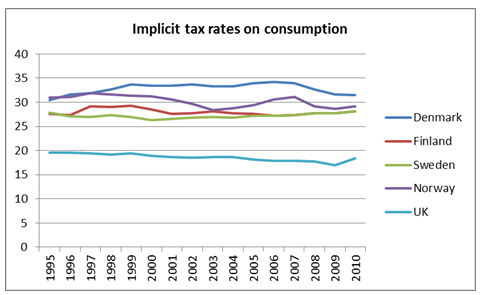
complied by STUC from Eurostat figures (2012) see table 5

 ..and that the same is true for labour: 

compiled by STUC from Eurostat figures (2012) see table 6


The UK and Norway have seen very constant levels over the past few years but there is a downward trend in the other Nordics: 

compiled by STUC from Eurostat figures (2012) see table 6

Note: the eagle eyed among you will have noticed that employer social contributions are included in the labour calculation. Does the story change if these are removed and stuck into the capital calculation instead? It appears not, although given the way that the implicit rates are calculated it’s difficult to be precise. But a crude calculation using Eurostat figures for employer social contributions as a percentage of all taxation suggests the following results - the UK still has a much lower ITR on labour although the ITR on capital is significantly increased for Finland and Sweden:

compiled by STUC using above Eurostat references for ITRs and Table A.3.1

5 Local taxation

A major difference between Scotland and the UK and the Nordic nations is the amount of taxation collected locally:

compiled by STUC from Eurostat data (2012) see table B.3
Indeed, Sweden, Denmark and Finland are respectively the 1st, 2nd and 3rd most locally taxed nations in the EU; the UK 19th.

There are of course other components to a nation’s tax regime such as environmental taxes, energy taxes, transport fuel taxes etc. I could go on. But, as a percentage of both GDP and total taxation there is little significant difference between Scotland/UK and the Nordics on these measures.

6 Conclusions

So comparing tax systems is hardly straightforward and if the debate over what Scotland might learn from the Nordic model is to be developed then the need for some comprehensive research is obvious.  

In the absence of such research being commissioned, what can be drawn with any certainty from the above analysis?
  • the Nordic nations are highly redistributive economies that fund this redistribution through tax systems that, although quite different, are considerably less progressive than that currently operating in Scotland: workers and consumers pay proportionately more, capital and high income earners proportionately less. Maintaining comparatively very high levels of well paid employment is of course fundamental to this enduring success of this model. High levels of taxation are clearly compatible with both greater equality and economic dynamism;
  • the Nordic tax systems may be more regressive but nevertheless manage to sustain much higher total tax revenues than more progressive systems; and, 
  • a much higher proportion of total tax revenue is raised at local level in the Nordic nations.  
That ‘Nordic countries have higher than average spending and progressive benefit structures but less progressive tax systems’ is hardly conducive to identifying simple policy measures that could be transplanted here. The lessons for say, the US, from the above might be quite straightforward (introduce a consumption tax!). Scotland would be in a very different position; faced with a choice to tax more and perhaps less progressively?

Scotland is a comparatively unequal nation with a comparatively progressive tax system. The Nordics are comparatively (very!) equal nations with some of the most regressive tax systems in the developed world. There is clearly a lot of scope for drawing policy lessons which may be superficially plausible and stroke the prejudices of Right or Left but these are likely to be both simplistic and wrong.

But let me try to make a start: 
  • The shift towards a more Nordic style economic and social model (under independence or enhanced devolved powers) is likely to be long-term, will involve radical change in much more than the tax system and decisions on tax are likely to be difficult and, for those on the Left, very possibly counter intuitive;
  • There are probably no single tax levers that will significantly increase the speed of this journey;
  • Generating higher total tax revenues and using the additional revenue wisely (e.g. investing in the supply side of childcare – the opposite of what Osborne has just done in the Budget) should be the goal; 
  • But significantly increasing total revenues could prove very difficult in a jurisdiction currently characterised by high levels of poverty, inequality and low wage work, foreign ownership of private industry, a rapidly diminishing ‘social contract’ (does it even make sense to speak of such?) and, most importantly, an economy/ labour market highly integrated with its neighbours. As Gus O’Donnell argues, ‘Scope for radical change in Scotland is at least in some key areas of taxation likely to be limited by the degree of integration of the Scottish and UK economies’;
  • Although it is always important to learn from success elsewhere, the opportunity provided by constitutional change is probably in designing a new system fit for Scotland’s needs as it finds itself in 2014/15/16. It’s a positive development that the Mirrlees report is now being promoted as the basis for such discussion although – again – easy policy solutions are highly unlikely to flow from such an exercise;  
  • It might be a shibboleth of the Left, but can too much can be made of progressivity? After all, taxes in the UK might be more progressive than in Sweden but rich people in Sweden pay much higher taxes than rich people in the UK. (Swedes in lower income deciles also pay more taxes but they are much more likely to be earning decent wages and working in reasonably secure jobs than comparable workers in Scotland). If this revenue is then redistributed, does it really matter whether the tax system is progressive? Rather than focusing on tax, much greater emphasis should be placed on other ways in which the Nordics manage to sustain greater equality such as much higher trade union density, wider collective bargaining coverage, comparatively huge investment in labour activation strategies etc.
Finally, the disparity in the proportion of taxation raised at local level is remarkable. Does this hint at another way of looking at the issue? Maybe better functioning democracies lead to better functioning economies rather than the other way round. I'll return to this and other issues in the next blog on economic development.

Stephen Boyd - STUC


Tuesday, 2 April 2013

Welfare Reform Measures and cuts to be introduced from April 2013


Below is a summary of the benefit changes that come into force this month   
Benefit cap:  As part of the Welfare Reform Act, from April 15 2013, there will be a cap on the amount of benefits a working-age household can receive, capped at the level of the average earnings of a working family.
Council Tax Benefit:  Council Tax Benefit is to be replaced by localised support for Council Tax. Local authorities will set up new schemes to support people in their own areas within a 10% reduced budget. The Scottish Government has announced that it will provide some protection for local authorities.
Disability Living Allowance (DLA) and Personal Independence Payment: The Government is to start replacing DLA with a new benefit called Personal Independence Payment (PIP) for people of working age. The government is hoping for a 20% reduction in expenditure by 2017 by bringing in this process. All working-age claimants already claiming DLA will eventually be reassessed for PIP.
Housing Benefit: In England, Wales and Scotland: Size criteria will apply in the social rented sector (e.g. council and housing association properties) replicating the size criteria that applies to Housing Benefit claimants in the private rented sector under the Local Housing Allowance rules. This means that people living in houses larger than they need (under-occupiers) will have to move to somewhere smaller or make up the difference in rent because their Housing Benefit will be reduced with a:

·        14% cut in Housing Benefit for those who under-occupy by one bedroom
·        25% cut in Housing Benefit for those who by two or more bedrooms


Local Housing Allowance rates: LHA rates will be increased in line with the Consumer Price Index instead of the market rents in each area. The connection with actual rents will be lost.

Universal Credit:
The current complex system of working-age benefits and Tax Credits is to be replaced by a new benefit called Universal Credit. National introduction will start in October 2013. In April 2013, the Department for Work and Pensions, working with HM Revenue and Customs and selected local councils, will launch its Pathfinder project to introduce Universal Credit to claimants within certain areas of the North-West of England. This “pathfinder” stage aims to ensure that Universal Credit is ready to go live across the rest of Great Britain later in 2013 and Northern Ireland in 2014.

Dave Moxham
STUC

Wednesday, 14 November 2012

No to Austerity: Yes to Jobs and Solidarity in Europe


The STUC is supporting the ETUC ‘s day of action. Today sees workers mobilising and standing up against austerity and for a new social compact in Europe. We want to see a real social dialogue, an economic policy that fosters quality jobs, economic solidarity between countries and social justice.

Austerity measures are dragging Europe into economic stagnation and recession. Growth has stopped and unemployment is rising inexorably. Cuts to salaries and social protection are attacking the European social model, worsening inequalities and fostering injustice.

Youth unemployment is one of the most damaging consequences of the obsession with the discredited economics of austerity. More than half of young people in Greece and Spain are without work, more than a third in Italy and Portugal, and 27% in Cyprus.

Currently in Spain more than13 million people (27% of the population) are living below the poverty line and more than 2,200,000 children are growing up in poor households. The extent of this crisis is severe and it is absolutely clear that further austerity measures cannot be pursued in this context without serious and long-term damage to society.

Yet the architects of austerity have no idea and no plan of how to rebuild economic growth – they are simply focused on keeping financial markets happy without regard to the social and economic costs.

This is why trade unions across Europe are taking action today under the banner of the ETUC. Workers are paying a steep price for the crisis and the austerity measures that have been imposed on them while it remains business as usual for corporations and financial institutions across Europe. We need to stop tax fraud and put an end to tax havens and tax competition between countries. Proposals like the financial transaction tax also have an important role to play to help repair the damage of casino capitalism.

To find out more about this action sign up to the ETUC facebook page: https://www.facebook.com/CESETUC     

Or follow the campaign on twitter: #14Nov2012

Also sign the ITUC’s pledge against austerity: http://act.equaltimes.org/en/node/144 

Helen Martin
STUC

Friday, 2 November 2012

Recent changes to immigration rules and how they affect families

The Coalition Government recently changed the rules for people wishing to bring their family into Britain. These changes affect migrant workers but they equally affect British nationals who have married people from outside the EEA and are bringing their partner into the UK for this first time, or who are returning from abroad with their family.

The changes are designed to ensure that British nationals do not need to claim benefits to support their family. It is important to realise that this does not represent a policy change and there were always provisions in place to make sure that this was the case. What this rule changes does, however, is severely limit the ability of low paid workers to have a family life as they place an earnings bar on the right to have your family with you in Britain.

The new rules mean that only someone earning more than £18,600 a year can bring their partner into the UK. This rises to £22,400 for a partner and a child, with an additional £2,400 for each further child sponsored. The new rules also mean that only the income of the British citizen (or visa holder) will be considered. This means that you could be married to a billionaire, an oil tycoon, or another low paid worker whose income would bring you over the threshold, but still deemed unable to support your family without recourse to benefits under the new rules.

This rule change is extremely concerning and seems to be an attack on the fundamental Human Right to have a family life for low paid workers.

These changes were recently debated in the House of Lords and this debate gives a useful overview of this issue.

http://www.publications.parliament.uk/pa/ld201213/ldhansrd/text/121023-0002.htm#12102355000231  


Helen Martin
STUC


Thursday, 18 October 2012

Stay of execution and promise of a great legal battle for refugees threatened with eviction and absolute destitution

Below is an update from the Glasgow Campaign to Welcome Refugees outlining the result of yesterday’s hearings into the forced evictions of asylum seeking families in Glasgow. The STUC has been supporting this campaign and is appalled that our asylum system works in such a way that people are systematically and routinely left destitute on our streets. We are glad that yesterday some progress was made in tackling this issue, although much is still to be done. We are also glad that the Glasgow Campaign to Welcome Refugees will be joining the march for a Future that Works on Saturday.


Refugees and campaigners who attended today's first court hearings in Court 14 in Glasgow Sheriff Court brought by the YMCA to evict the remaining refused refugees, witnessed a remarkable event. While a number of undefended cases went through on the nod, 8 of the cases were defended and the case for eviction challenged. The first effect was to extend the cases into December, giving the refugees at least a stay of execution, the longer and more significant outcome could be to develop a group of test cases which will challenge the legality of the use of absolute destitution as an arm of government policy. Some of the cases were defended by an advocate, an unusual enough event in the eviction courtroom, but an indication of how seriously the refugees' lawyers intend to pursue these cases.


As one of the legal firms involved put it, in more measured terms:

"Latta and Co. Solicitors represented several clients who were faced with eviction at Glasgow Sheriff Court today. The cases were successfully continued to consider challenges raised to the lawfulness of the eviction proceedings. Additional challenges were also raised in respect of potential human rights breaches involving destitution issues. These will be considered at an evidential hearing which has been set for December. The clients are allowed to remain in the accommodation until the matters are fully considered."


Glasgow Campaign to Welcome Refugees and numerous other organisations will continue to campaign until our society is rid of this barbarity. Not only out of sympathy with refugees but for ourselves too for what governments can get away with doing to demonised refugees today they can do to the demonised "undeserving poor' tomorrow.

Jock Morris
Chair
GCtWR


Friday, 5 October 2012

Black Workers are suffering because of austerity and will be marching on 20th Oct.

The STUC is having its 16th Annual Black Workers Conference this weekend in Glasgow. Black Workers from a variety of workplaces and sectors across Scotland will be gathering to discuss issues that are important to them in their workplaces and in their daily lives.


The theme of this year’s conference is ‘Our Scotland ....Beyond Colour’ which represents the sort of Scotland we want to create. Too often we hear politicians saying ‘we’re all in this together’ but this phrase rings hollow. We want to see a Scotland were everyone truly is valued, regardless of their race, gender, sexuality or disability and we want to make sure that Black and Ethnic Minority people feel that their contribution to our country is recognised.

As chair of the Black Workers Committee and from work within my own union, I know that Black Workers are suffering in the current climate. Too often we hear stories of Black Workers being the last to receive their shift allocations, and the first to have their hours cut. We also know that racist bullying and harassment is a part of many workers daily lives and that tensions in workplaces often rise as cuts begin to bite.

It’s not right that Black Workers should have to bear the brunt of this crisis. Nor should we allow the Government’s policies of austerity to divide us. All workers Black or White, old or young, public or private sector, need to stand up to this Government’s ideological and damaging economic policy.

That’s why I’m marching on the 20th October, and why I’ll be proud to carry the STUC Black Workers’ banner. It’s our Scotland and we need to fight for it.

Nazerin Wardrop – Chair, STUC Black Workers’ Committee

Friday, 29 June 2012

In Support of Aid


The STUC is supporting Mark Hendrick’s Private Members Bill to legislate for the commitment to spend 0.7% of UK Gross National Income on international development. The second reading of his Bill will take place on Friday 13 July in Westminster.

This Bill is being introduced by a Labour MP despite a pledge in the Coalition Agreement to introduce legislation within the first session of this Parliament. The Coalition now only pledges to legislate by 2015 – which suggests that the pledge is in the process of being dropped, as quietly as the Government can manage.

The Government, however, still maintains that they will reach the 0.7% target in the next financial year, even though this requires increasing the aid budget by a third in a single year.

The STUC is therefore calling on trade unionists and those with an interest in anti-poverty work to back Mark Hendrick’s Private Members Bill which puts this spending commitment on a legislative footing.

We are asking you to contact your MP and encourage them to attend the debate on the 13 July and support the Bill. Contact details for your MP can be found at
http://www.theyworkforyou.com by simply putting in your postcode.

In times of economic hardship it is easy to forget our wider responsibilities in the world. But the UK has a duty to support developing nations and a key part of this is the 0.7% spending commitment.

This pledge was in all three major Westminster parties’ manifestos, so it is right that we should hold them to it. But it’s also about making sure that governments in the global south know the level of aid that they can rely on over years to come, which enables them to plan ahead and make the most of the money that we provide.

Helen Martin - STUC

Thursday, 5 April 2012

Disabled Workers, the Race to the Bottom

Guest Blog by Bill Scott, Manager, Inclusion Scotland

The proposed closure of Remploy factories quite rightly provoked outrage. Whatever anyone’s opinion might be of supported workplaces it is a fact that 85% of the disabled workers sacked during the last round of Remploy redundancies have yet to find work. That means that the vast majority of the Remploy workforce affected by the current round of closures are being condemned to a lifetime on the dole.

‘But don’t worry’, says the UK Government, ‘the money saved from closing the Remploy plants will be reinvested in Access to Work’. Forget the morality of stealing funding that supports one group of disabled workers to fund another group to keep their jobs and simply ask “Will this work?”.

Access to Work (AtW) funding is only available to disabled people starting or continuing employment. It is of no use to unemployed disabled people wanting to get qualifications or to volunteer. In addition the adaptations that AtW will fund have been severely restricted. What effect has that had on take-up?

There are 668,000 disabled people in Scotland aged between 16 and 64. In 2009/10 AtW supported 2,790 of them to keep or get employment at a cost of £6.4 million. So just 0.4% of Scots disabled people of working age received any AtW support.

The proportion of disabled people being assisted through AtW in Scotland is also way below the UK average. In the UK there were 35,820 disabled people assisted through AtW in 2010/2011. Proportionately that means 3,500 disabled people in Scotland should have been helped meaning AtW take-up in Scotland is about 20% lower than it should be.

The number of new customers being supported by AtW has also fallen dramatically. In the years 2008/9 and 2010/11 between 6,500 and 8,000 “new” disabled people were helped in the first 6 months of each year. But in the first 6 months of 2011/12 the figure for new customers helped had fallen to under 5,000. That’s around a 25% drop year-on-year. Far from AtW supporting more disabled people it’s actually supporting less. Instead of Government platitudes disabled people need real jobs and genuine support to access and keep them.

There has to be a Better Way...

For further information on AtW and its success, or otherwise, in supporting disabled workers in the workplace please access the AtW official statistics  available on the DWP website.

Bill Scott
Manager, Inclusion Scotland

For further information on the work of Inclusion Scotland please vist their website


Friday, 16 March 2012

SAVE the Equality and Human Rights Commission

PCS Members at the EHRC were on strike on the morning of Thursday 23rd February to protest about government cuts of 63% to its budget and 72% cut to staffing, compared to 2007 levels. This was followed up by a leafleting exercise on Tuesday13 March to seek further support from members of the public.

In Scotland, a properly resourced EHRC which maintains its core functions is necessary to address the equality agenda, given the very different political, legal and economic landscape. The proposed cuts would threaten high profile work in Scotland – such as the Disability Harassment Inquiry, Human Trafficking Inquiry, guidance to public bodies on their obligations under Equality Law and the EHRC hosting of Independent Living Scotland.

Their Scottish Helpline deals with over 5000 calls per annum from service users who feel they have been discriminated against; the largest proportion from Scots who have been subjected to disability discrimination. The Scottish Helpline also provides a UK wide service, taking tens of thousands of calls more on a UK wide basis. Many more Scots receive specialist advice in writing

The nature of the advice provided by the EHRC is highly technical; there is no other organisation with an equivalent level of experience and knowledge who can fill this gap and provide a similar quality and level of service. The cuts would also jeopardise the ‘transfer of expertise’ services and events ran by the casework team for other organisations advisors and employees, whilst Public Sector Equality Duty enforcement would be less vigorous.

The Commission losing its funding function is already leaving a gap in the finances of well respected organisations such as Govan Law Centre, Glasgow Disability Alliance, Equality Network and Central Scotland Racial Equality Council, to name just a handful. The effects of these cuts will be felt sharply by the most vulnerable sections of Scottish society. In addition the reductions in funding currently being experienced by charities and other 3rd sector organisations will create an equality and human rights advice desert in Scotland.

The STUC would urge all trade union members and the wider general public to show your support now by signing the No 10 petition to save the EHRC  to protect not only a valuable public service but also our human rights that are under constant attack by the coalition Government.

Ian Tasker
STUC

Wednesday, 25 January 2012

Songs for Social Justice: Gil Scott-Heron - A Message to the Messengers


Speaking ahead of the Songs for Social Justice Festival on Thursday, SweetS (Northern Xposure) said, “Music has always been at the heart of many civil rights movements and revolutions, and it also acts as a vehicle for different cultures and faiths to have some common ground. It is something that reaches so far into our very being and existence that it resonates with each and every one of us on a profound level, indeed even before we can say our A, B, C, D we find it is easier to communicate with a harmony or a bit of melody.  Therefore it is NRNXPO's mission to promote music for social justice in all form's and across all genre's.”

Rap and Hip Hop started out in the 1970’s as a way of communicating a social and political message while having a good time.

Gil Scott-Heron is often credited with being the Godfather of Rap, he was rapping to music by 1970, some time before Kool Herc and Afrika Bambaataa created Hip Hop as a means of bringing communities together, offering young people a route out of gangs and encouraging social harmony.

Gil Scott-Herons’ lyrics focussed on the social and political issues of the time. His music still resonates today and he can still find a new fan-base amongst young people. His 2010 album I’m New Here, was remixed by Jamie Smith of The XX and released in 2011 as We’re New Here.

It is difficult to choose just the one track from Scott-Heron’s extensive, educational and inspiring output, obvious choices would be The Revolution Will Not Be Televised, The Bottle or Johannesburg. However, today’s choice comes from his 1994 album Spirits. A Message to the Messengers calls on rappers, musicians and young people to remember their history and heritage and use this knowledge and understanding to promote positive social change.


Gil Scott-Heron - A Message to the Messengers


Songs for Social Justice Dance Night featuring guest DJ Jerry Dammers -
o      Thursday 26th January
o      STUC Centre, 333 Woodlands Road, Glasgow
o      6.45pm – midnight
o      Tickets £8/£4 - Available direct from the STUC - 0141 337 8100


Tuesday, 24 January 2012

Songs for Social Justice: SOPA / PIPA Blackout Day Protest Songs


This blog was written by John Powles at the Alistair Hulett Memorial Trust. STUC Unions Into Schools and the Alistair Hulett Memorial Trust have worked in partnership on the Songs for Social Justice Festival. We would like to thank John for writing this blog.

On Wednesday 18th January 2012 many internet sites intentionally blacked out for the day in protest against the SOPA (Stop Online Piracy Act) and PIPA (Protect IP Act) legislation now being advanced in the USA. The day of protest has been judged a success by some of the major organisations involved. Wikipedia stated "More than 162 million people saw our message asking if you could imagine a world without free knowledge. You said no. You shut down Congress's switchboards. You melted their servers. From all around the world your messages dominated social media and the news. Millions of people have spoken in defence of a free and open internet." Meanwhile Facebook founder Mark Zuckerberg urged people to protest saying "Tell your congressmen you want them to be pro-internet. We can't let poorly thought out laws get in the way of the internet's development. Facebook opposes Sopa and Pipa, and we will continue to oppose any laws that will hurt the internet."

Of course the internet with sites like YouTube, Facebook and the rest is a powerful tool for distributing activism against social injustice, including using songs as a vehicle for protests. Needless to say the SOPA / PIPA protests have led to the creating and posting of songs. The following examples demonstrate just how easy it can be to make protesting voices heard – no expensive equipment is required, no record industry moguls have to be grovelled to, no media pawns of government have to be persuaded – just do it and post it.

The first sample uses the age old method for creating a song of social justice – the adoption and adaption of an existing well known tune and lyric – in this case Don Maclean’s American Pie. Created by LaughPong, The Day The LOLcats Died - #SOPA #PIPA Protest Song [http://techcrunch.com/2012/01/17/the-day-the-lolcats-died/] includes some pertinent lyrics:

”Why, why are laws a thing you can buy? / They got paid off, should be laid off, re-election denied / Our web means more than lawyers, lobbies and lies / So speak up before the internet dies / Speak up before the internet dies”.

LaughPong - The Day The LOLcats Died


Finally in this brief selection Stop the SOPA Song is just a guy in his room with an acoustic guitar and some very clever lyrics:


Songs for Social Justice Dance Night featuring guest DJ Jerry Dammers -
o      Thursday 26th January
o      STUC Centre, 333 Woodlands Road, Glasgow
o      6.45pm – midnight
o      Tickets £8/£4 Available direct from the STUC - 0141 337 8100