It’s going to be a very warm June whatever the weather.
There was a ‘wait and see’ moment on April 1st of this year following the formal introduction of the hated ‘bedroom tax’. Would the opposition subside following combination of last minute climb downs and the reality of the legislation passing?
The early indications are that this will not be the case. The Scottish media, particularly the Daily Record is reporting, almost daily, stories of individuals and families affected and accounts of heavy handed eviction notices (some no doubt as a consequence of bad bureaucracy rather than political intent).
This is the fuel which will ensure that the campaigning momentum continues. New local groups are being formed almost daily and there is a coming together of a whole number of campaigning organisations, trade unions and equality groups committed to continue the fight.
There is no single organisation which can or should claim to represent all the campaigning interests or to have a monopoly on ideas for the best tactics. The No2Bedroom Tax campaign has played a key role in circulating information and seeding local campaigns. It played a massive role in the March 30th Demo in Glasgow and has also been active in bringing together local groups across the UK in discussing future co-ordinated action. The Scottish Anti-Bedroom Tax Federation has brought together a number of local groups, particularly of the west coast, and some trade union branches to form a structure. Its founding statement can be found here and its public face heavily focuses on physical opposition to evictions - more of which later. Some of the biggest anti-bedroom tax meetings have been organised by the mainstream political parties Labour and SNP. Add to this the high profile campaigning activities of Govan Law Centre and of Shelter Scotland not to mention skilled political activists such as Citizen Smart (see his Youtube Bedroom Tax song here) and Mary Lockhart and the ingredients for a broad based campaign are obviously present.
There are of course differences of approach. These can be separated into four broad strands although many groups and individuals would support pursing more than one.
Defeating the Bedroom Tax at Westminster through repeal either during the current parliamentary term or post 2015.
Many things can happen over the next two years. The Coalition remains weak and Liberals are deeply uncomfortable about the tax and about their current electoral prospects. A continuing campaign across the UK and targeted at specific MPs is a must.
Scottish Parliament action to prevent evictions through Bedroom Tax and provide financial support.
Legislation could be introduced as proposed by Govan Law Centre to ensure that there would be no evictions for Bedroom Tax arrears. Of course this would not top debt mounting up or prevent local authorities and housing providers from pursuing debt through other means but it would mean no-one losing their house. It would be problematic for housing associations in particular with respect to their revenue streams. Shelter has proposed that any such action should also be supported with Scottish Government funding to obviate the impact on personal debt and housing provider funds. Alternatively, a probably most persuasively, the Scottish Government could supplement the Discretionary Housing Payment funding provided by Westminster to expand to all those hit with the Bedroom tax, the support they need to avoid arrears.
Council ‘No Evictions’ policies
The First Minister has announced that all SNP led councils will not evict during the first year and a number of other councils have said the same including Edinburgh. Others have more nuanced policies which imply that every other route and then some will be pursued before eviction is sought. The limits of these policies are partially in relation to time (what happens next year) and also are only of any use to council house tenants. For instance GHA residents in Scotland’s largest city are are helped not a jot by such policies.
Physical opposition to evictions
Although there should be a lively and fear free debate about what action should be taken if and when individual tenants face eviction, I believe that the concentration by some on this tactic is a mistake. Even in the worst case scenario, and not withstanding some of the ridiculous resort to threat of some housing providers, mass evictions are unlikely any time soon. Successfully opposing evictions through court action, winning policies at housing provider level or through civil disobedience will not remove debt. As indicated above, there are a whole range of campaigning aims to be pursued to avoid the crisis of evictions through Bedroom Tax.
What happens next?
On June 1st the Anti-Bedroom Tax Federation has called a demonstration in Glasgow. The latest information is that it will be a rally rather than a march and speakers have still to be announced.
On June 8th a demonstration has been organised outside Tory Party conference in Perth
On June 26th the Petitions Committee of the Scottish Petition will consider the Govan Law Centre petition. A lobby is expected.
And watch out for STUC campaigning activities on austerity in last week of June. This will include a major bedroom tax event – details soon ...

The blog of the 'There is a Better Way' campaign by STUC staff about policy issues that are, or should be, in the news and guest contributors on issues of social justice. Written from a STUC perspective, contributions will often cover areas where there is yet no settled STUC policy and go into areas in more detail than our formal decisions. We welcome debate and we don’t expect everyone to agree with us, but we will remove any comments that are offensive, irrelevant or otherwise annoy.
Wednesday, 22 May 2013

Tuesday, 14 May 2013
What's happening in Scotland's local labour markets?
Not usually one for bold predictions, I hereby declare a
strong belief that political reaction to the new labour market statistics for
Scotland (published by ONS at 9.30am tomorrow morning) will be shrill and
unenlightening. Cherries will be picked, scarcely deserved credit claimed
and/or unwarranted blame apportioned. Such is life on the third Wednesday of
the month. It’s all as inevitable as it is crushingly tedious.
The monthly bunfight is predicated on Labour Force Survey
data for employment, unemployment and inactivity. The LFS sample size for
Scotland is approximately 5,800 households a year. I’ve blogged recently about
the Scottish Government’s use of experimental LFS data for which the sample size
is considerably smaller.
Unfortunately it’s not widely known that the Scottish
Government funds ONS to boost the sample size for Scotland each year to 20,000
households. These data are then combined with similar boosts to the English and
Welsh LFS in the Annual Population Survey. The APS therefore provides a more
accurate and detailed picture of the Scottish labour market albeit one that
lags the latest (non-boosted) statistics that will be published tomorrow.
The Scottish Government draws on the APS to publish an
excellent annual report ‘Local Area Labour Markets in Scotland’. This is
something of a pioneering study which led the way in shedding light on rising
underemployment some time before ONS caught up. So it’s a crying shame that the latest edition
published on 8 May (covering 2012 APS) was, as far as I can tell, completely
ignored by the Scottish media for it provides a much fuller picture of the
reality of the labour market as confronted by real people in real communities
than the monthly ONS release.
What does the 2013 report tell us?
- The 2008-2013 mini depression has exacerbated long-standing regional inequalities. The report bravely concedes that progress towards the Scottish Government’s cohesion target has reversed: between 2011 and 2012, the gap in employment rates between the three local authorities with the highest employment rates and the three local authorities with the lowest employment rates increased by 2.8 percentage points from 16.3 to 19.1 percentage points. The poor performance of Glasgow (see below) had a relatively severe impact on the overall rate of the 3 worst areas due to its size.
- Some welcome progress on employment growth over the year was insufficient to compensate for the damage done over the past five years: just over half of local authority areas saw an increase in their employment rates over the year, while all but two local authorities (North and South Lanarkshire due to significant increases of 4.1% and 4.3% respectively in the saw female employment rate) reductions between 2008 and 2012.
- Glasgow saw the largest decrease in employment rate…down 4.1% to 59.7%, while its employment level decreased by 15,500…over the year Glasgow has seen a large shift out of employment into inactivity (with the level of inactive students aged 16-24 up around 11,000 over this period).
- Perhaps surprisingly, the male employment rate decreased from 75.1% to 74.6% while the female employment rate increased slightly from 66.5% to 66.8%.
- The youth employment rate (16-24 year olds) in Scotland decreased by 1.4% over the year, from 54.6% in 2011 to 53.2% in 2012. A total of 16 local authorities (including Glasgow and Edinburgh) saw an decrease in their youth employment rate, whilst over the same period the remaining 16 saw increases. The youth unemployment rate (16-24) in Scotland was 20.7%, 0.2 percentage points lower than the rate in the UK. The rate in Scotland has increased by 7.1 percentage points since 2008, higher than the increase of 5.9 percentage points in the UK over the same period. There is nothing in this report to support the Scottish Government's proposition that youth unemployment has fallen by a third over the past year.
- The number of people in full-time work continues to decline: in 2012 73.2% of people in employment were working full-time, compared to 73,6% in 2011 and 76.2% in 2008. Over the year the percentage of people in full time work has decreased in 17 local authorities and since 2008 has decreased in 28 local authorities.
- The increase in underemployment slowed in 2012: there were 243,000 workers underemployed (ie willing to work more hours), an increase of 2,600 over the year and 68,900 since the start of the recession in 2008. The underemployment rate (those underemployed as a proportion of all aged 16+ in employment) in 2012 was 10.0%, up 0.1% over the year and 3.0% since 2008. Underemployment levels are highest amongst part-time female and full-time male workers.
- At the start of the recession in 2008, 268,500 (10.6%) of the 16+ workforce were self employed. By 2012 the level of those self-employed had increased to 301,700 (12.2%), an increase of 33,200 with around 60% of the increase due to a rise in self-employed males. Those working part-time made up 85% of the total rise in self-employment in Scotland in 2012. The level of 16+ employees has decreased from 2,242,600 in 2008 to 2,145,700; a decrease of 96,900.
- The report provides no comfort to those looking for signs of rebalancing: since 2008, there have been statistically significant changes in the proportions employed within ‘manufacturing’ (down 1.6%), ‘construction’ (down 2.3%), and ‘banking, finance and insurance’ (up 2.2%).
- Private sector job growth between 2011-2012 (10,600) did not fully compensate for public sector job losses of 13,900 – the paper does not break these jobs down into FT/PT etc.
- In 2012 33,000 (13.3%) of 16-19 year olds were not in education, employment or training. The level of NEET had increased by 1,000 (0.9 percentage point) since 2011.
- Just under 48% (101,600) of all unemployed people in Scotland have been unemployed for less than 6 months, while just under 33% (70,100) have been unemployed for 12 months or more.
- The unemployed rate for disabled people (for those aged 16-64) in Scotland rose by 1.2% over the year to 12.6% with the level increasing by 4,000 to 50,500.
- In 2012, 25.4% of all people in Scotland aged 16-64 who were inactive wanted to work, compared to 24.6% in 2011.
Friday, 10 May 2013
Scottish Government Banking Strategy: some early thoughts
Earlier today, the
Scottish Government published ‘Sustainable, Responsible Banking: a strategy for Scotland’ the purpose of which is to ‘set out what Scottish Ministers consider to
be the key principles of a sustainable, responsible and healthy banking sector
in Scotland’.
It’s a disappointing
paper. Some fundamental issues are dealt with in a very flimsy manner or,
worse, ignored altogether. The paper is imbued with a worrying naivety (‘in the wake of the crisis, the attitudes of
consumers, UK and EU regulators and the banks themselves have changed’) and
a level of optimism about the benefits of greater competition that might kindly
be described as unjustified.
The STUC will
publish a full response in due course but here are my early thoughts on some
specific issues:
1 Key sector?
The strategy
implicitly accepts the approach whereby banking, as part of ‘Financial and
Business Services’ is treated a priority or ‘growth’ sector by the Scottish
Government. Publication of the banking strategy should have provided an
opportunity to state what has been apparent since 2007: chasing growth in
banking as an end in itself is a mugs game.
A too large banking
sector absorbs resources (e.g. engineers, mathematicians etc) that could be
more productively deployed elsewhere. It contributes to higher inequality,
destabilises the wider economy and exerts a degree of political influence that
cannot be reconciled with a healthy democracy.
Debating whether an
independent Scotland could have coped with the crisis of 2008 is ultimately
pretty pointless. The pressing issue is surely what needs to be done to avoid
future crises under any constitutional scenario. This requires Government to measure success
in banking not by the sector’s output but whether banks are fulfilling their
fundamental purpose of allocating capital efficiently.
2 Too big to fail, too complex to manage
The strategy doesn’t
address issues of scale which, to put it mildly, is something of an oversight.
As was surely proved beyond all reasonable doubt by the crisis, large financial
conglomerates are very dangerous entities. They enjoy an implicit public subsidy which hands them a major competitive advantage over smaller players. (Again)
they hoover up resources and exert a nefarious political influence. Boards are
unwilling or unable to exert effective oversight. Executives don’t understand
the businesses they purport to run.
So here was an
opportunity to state categorically that serious structural as well as
regulatory change is required to make the system safer and more efficient. The
opportunity was flunked.
3 Competition
Scotland’s banking
sector is highly concentrated; more so since the crisis enforced consolidation.
Therefore support for greater competition has never been stronger. Proposals
include liberalising entry conditions and reducing switching costs. Interestingly
other barriers to entry such as the remuneration of executives (the strategy
doesn’t address remuneration) are not mentioned.
The recent LSE Growth
Commission (UK) report argued that increased competition would have a variety of benefits:
"It would encourage banks to seek out profitable lending
opportunities more assiduously. It could also stimulate relationship lending as
retail banks focus on more mundane finance rather than ‘casino’ activities”.
But how well does
the competitive mechanism function in the retail banking market and would more
players necessarily lead to the benefits described above? Many have their
doubts. Here’s the economist Roger Bootle (no socialist he) in ‘The Trouble with Markets’ his excellent book on the crisis:
If ‘asymmetries of information and opacity in
charging structures’ persist then the supposed benefits of greater
competition will not be realised even if more players enter the market.
4 Workers
The strategy
includes a section on ‘professionalism and standards’ which, as the title
suggests, is very tightly focused on the qualifications and professional
accreditation of senior staff.
There is no mention
of the retail counter staff or call sector worker; workers who in the recent
past have suffered redundancy or the intensification of performance management
regimes. Banks are no longer a good place to work. The golden rule of Scottish
and UK economic development policymaking is once again strictly adhered to: do
or say nothing which might possibly be perceived as infringing on managerial
prerogative.
5 Restoring Trust
Consider this:
“The banks want to change the public’s often negative
perception of them and they recognise that the only way to do that is to prove
to their customers that the desire to change is genuine and that it is for the
long term. That is a hugely important step and one that deserves to be
supported”.
I can only say that
that this is not the world in which I live.
6 Scottish Business Development Bank
The strategy
includes a laudable proposal for the Scottish Investment Bank to evolve into a
Scottish Business Development Bank. Although not presented in these terms, this
is clearly an attempt to overcome a long standing and extremely serious
structural problem in the Scottish economy: the failure of the financial sector
to support productive, growing and innovative businesses with patient and
committed capital.
But the proposal is
messy and confused, lacking in detail and ambition. It fails to mention that
innovation is currently heavily penalised by banks (for perceived higher risk)
and that supporting such activity should be the primary purpose of such an
institution. Another opportunity missed. Give us something like this instead?
7 Diversity
On the day that the
full extent of the Cooperative Bank’s problems were revealed, it’s good that
the strategy promotes the value of alternative business models and different
forms of ownership. The expanded role that credit unions could play in
providing services to customers that banks have hitherto refused to service is
also highlighted.
But the strategy has
nothing substantial to say about how a greater role for such institutions might
be achieved. This isn’t something that can be wished into happening.
This leads on to the
final issue: what can be achieved at Scottish level under current or new
constitutional arrangements? The strategy states that ‘independence would allow Scotland access to the necessary levers to
encourage a responsible, sustainable banking sector that better meet the needs
of the Scottish people, that enhances Scotland’s competitive advantage and that
better enables us to address the economic challenges facing us’.
At the moment
nothing can be achieved at Scottish level to reform banking. But it’s not
immediately clear to me that the macroeconomic framework proposed by the FiscalCommission would provide any additional levers in this respect under
independence. Scotland and the UK would be in a banking union with whole UK
institutions in charge of oversight. It remains to be seen whether other
important responsibilities – e.g. corporate governance – will be exercised on a
whole UK basis.
If nothing else,
maybe publication of this strategy will provoke a debate about the future of
banking in Scotland that might force the Scottish Government to address these
issues head on in the white paper if not before. I hope so.
Stephen Boyd - STUC
Thursday, 9 May 2013
So much for the Robens Vision for Health and Safety

Guest Blog by Kevin Rowan, Head of the TUC's Organisation and Services Department
When the Health and Safety Executive was set up, almost forty years ago, it was considered important that it had the confidence of both employers and employees and rightly so. For that reason the Health and Safety Commission was set up to agree any new regulations. There were three worker representatives (proposed by the TUC), three employers representatives (proposed by employers’ groups) and up to three others. No decision could be made without the support of both employers and employee representatives. This meant that any changes to health and safety law were seen to have come about by consensus, achieved through a common purpose of improving health and safety in the workplace.
This system has survived almost intact, although there have been some changes. When the Commission was replaced with a Board the membership was expanded from a maximum of 9 to 11, although the three worker and three employer representatives remained. Also in recent years decisions have been made which did not have the support of both sides of industry, such as the decision to exempt some self-employed people from health and safety laws.
However, the tri-partite principle remained and, as a result, unions at least felt they had a voice after all the law still required the Secretary of State to consult with “bodies representing employee interests” before appointing the three employee board members, and each of these three were active trade unionists supported by the TUC.
Earlier this year there was a vacancy for one of these seats. The TUC supported a candidate who has huge respect within the trade union movement; Matt Wrack, the General Secretary of the Fire Brigades Union. Matt is a member of the General Council of the TUC and has a wealth of experience in safety issues. He also has strong links with the world of work.
Last month the Government announced that they were going to appoint someone else. They did so without any meaningful consultation with the TUC, or any union bodies. They hand-picked a retired union general secretary who had not been nominated by a single union (even his own previous union).
Now this is not about the individuals, it is about who can decide who represents workers. If the government can decide this without any discussion with trade unions then it makes a mockery of the whole process. As Hugh Muir pointed out in the Guardian, they could just as easily appoint Norman Tebbit, after all, he was in a union once.
The decision not to appoint Matt Wrack shows exactly what the Government wants, which is a compliant board there to administer the organisation and make sure it delivers what the government wants. It wants to smother any independence and any challenge.
As a result we will end up with a board of professional committee-members, something the Nolan Principles on public life were designed to avoid. The TUC has always nominated people who still have a strong and current link with the world of work. If you look at the present board, with the exception of the TUC nominees, all the other ordinary members of the board of the HSE are either retired or semi-retired consultants. I somehow doubt that this is what Robens* intended when he recommended a tri-partite HSE.
This may seem like sour grapes from the TUC after we did not get our own way, but that is far from the truth. Of course, we understand that the Secretary of State has the final decision, but if the HSE Chair and DWP minister want to maintain trust in the HSE, the onus is on them to show that they have listened to the voice of working people and that the successful candidate carries our confidence.
We care about the HSE, and more importantly we care about health and safety. It was recognised 40 years ago that the most effective regime was one which involved collaboration and tri-partitism. Ditching that model means that the HSE will lose all its independence and become simply a blunt instrument for politicians to use to push through their own short-term agendas, as we are seeing at the moment on issues such as regulation, inspection and enforcement.
The losers will not be the TUC, but the credibility of the government’s claim to have an independent HSE and ultimately the workers whose lives and health will be put at risk.
*Lord Robens produced the report that led to the creation of the HSE.
How is overseas aid for Bangladesh spent?
Not on improving health and safety and workers rights but on television shows appears to be the answer.
The death toll following the Rana Plaza collapse in Bangladesh on the 24th April has now risen to 912. Latest news report from Bangladesh show that, in a separate incident, a further 8 Bangladeshi people have lost their lives in a fire in another Bangladeshi garment factory in the Mirpur industrial district in Dhaka after being overcome by toxic fumes from burning acrylic clothing. But for the fact that the workforce had gone home the death toll from this latest incident could have been far greater.
These 920 deaths, with more likely from the Rana Plaza tragedy, follow an earlier fire in November when 112 workers lost their lives in another garment factory fire in Tazreen.
The loss of 1024 workers in little more than six months is a disgrace and prompted the STUC to have a look at where UK aid for Bangladesh is spent.
An article in the Sunday Telegraph on the 11th November last year questioned where the Department for International Development was investing aid in Bangladesh.
Investment to aid international development in Bangladesh included:
- £5 million for a Question Time-style show and £546,000 for a phone line announcing what debates are coming up in the country’s legislature.
- £21.2 million on a road maintenance project, later pulled due to “fiduciary irregularities” after it emerged that less than 10 per cent of the funding had been spent on roads.
- £22.7 million to bail out debt-laden state-owned businesses.
- £13.1 million on training 1,700 civil servants to “develop and deliver pro-poor policy and practice”.
Not one penny seems to have been spent on improving the lives of Bangladeshi workers. The United Kingdom Government has maintained a silence on this issue, a fact that is hardly surprising given their attacks on workers rights including our well established health and safety regulation and enforcement body, the HSE.
Since the Rana Plaza tragedy, the Bangladesh Government has apparently closed 18 garment factories due to safety concerns. However Bangladesh reportedly has around 5 million people working in the garment industry in 5000 factories. Those workers are mainly women with many being rural migrants, seeking employment in this low wage industry in order to escape the abject poverty associated with rural life in Bangladesh.
Closing 18 factories out of 5000 would suggest that conditions in these 18 factories were appalling but the workers will have lost their jobs and their livelihoods. Some may say that this is a price worth paying but we are not in their shoes. The answer has to be a safer garment industry with higher wages, providing a better standard of living for Bangladeshi workers.
Bangladesh marked this years May Day with demands for improved health and safety, a fitting demand to mark May Day, our day and a day for workers throughout the world. The United Kingdom Government could ensure that further needless loss of life is prevented by ensuring at least some of this overseas aid is spent on protecting workers. The should also be pressing United Kingdom retailers to provide funding for health and safety initiatives to protect lives and improve the health and wellbeing of garment workers in Bangladesh.
Current talks are taking place between retails and the Bangladeshi Garment Manufacturers and Exporters Association. Any body arising from these talks will not be independent, it will only deliver what the industry wants and will continue to be driven by what the retailer's buyers are willing to pay for the products.
The United Kingdom Government and those of other European countries have to take a lead and work with international trade unions and NGOs to develop an independent fire and health saefty inspectorate for the industry along the lines suggested in the Bangladesh Fire and Safety Agreement. This will save lives.
It may mean that we pay more for our clothes but surely that is a price worth paying.
Friday, 3 May 2013
Has youth unemployment fallen by a third?
The latest
labour market statistics for Scotland (see table HI11)) published
on 17 April were undoubtedly the most positive for some months: unemployment
fell (slightly), employment rose (considerably) and inactivity fell (slightly). At FMQs the following day, the First Minister quite properly emphasized the good news, taking care to stress that ‘over the last year youth unemployment has declined by a third’.
Given that total
unemployment has fallen by only 10% over the same period, the decline in youth unemployment would indeed be
remarkable if accurate. But is it? Well, not unusually for labour market
statistics, the picture is somewhat complex...
The claim that youth
unemployment fell by a third in Scotland over the past year is based on
statistics published separately from the headline employment, unemployment and
activity statistics that usually determine the course of political debate.
These figures do indeed show Scotland outperforming the rest of the UK to a
significant degree (albeit that a fall of 31% doesn’t quite meet the stretching
technical definition of ‘one third’!):

Before anyone is
tempted to scream foul, it should be noted that the designation ‘experimental’
doesn’t necessarily render the statistics invalid. ONS concerns may well relate
to other nations/regions of the UK with a smaller sample size than Scotland.
OK, so let’s assume
that the Scottish statistics are correct. They should at least broadly align
with other measures of unemployment; measures that the Scottish Government’s
own briefings confirm as more reliable than the experimental LFS figures.
The Scottish
Government’s youth unemployment statistical briefings present the experimental
LFS data accompanied by data drawn from the Annual Population Survey which it informs
us is ‘based on a larger sample than the
quarterly LFS information and provides a more reliable estimate of economic
activity by age for Scotland’. What do APS data show? An encouraging fall
in youth unemployment but well short of the one-third claimed by the FM and
much more in line with the total fall in unemployment (all ages) over this
period:

The following chart
is derived from the Scottish Government’s latest briefing (April 2013 - see previous link) and shows the change in
the APS and experimental LFS rates over the latest year for which data are
available:

Clearly the performance
of this cohort is much less impressive on the APS measure: a much smaller fall
in unemployment, a fall in employment and a significant rise in inactivity. Again,
this performance is much more in line with the labour market as a whole.
However, the APS data lags the LFS data – so perhaps a big fall in youth
unemployment occurred at the start of 2013?
If so, it’s
reasonable to expect that this would be reflected to at least some extent in
the claimant count (JSA) which is the most up to date and reliable measure
(although obviously narrower as it only includes those on JSA – LFS and APS
includes all those unemployed, seeking and able to start, work) given that it
is drawn directly from the Jobcentre Plus administrative system. What’s
happening in the claimant count?
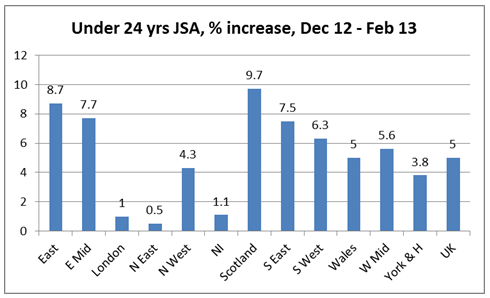
JSA is actually
increasing over the recent period and Scotland has seen a bigger increase than
any other nation/region of the UK. However, the latest month for which we
have figures seen all nations/regions of the UK experience a fall in youth JSA –
Scotland’s fall is below the average for the UK but not by a huge margin - but
not of a sufficient scale to see a return even to late 2012 levels:

It’s definitely
worth stressing that over the year youth JSA has seen an encouraging fall but, again,
this is much more in line with the APS youth data and total fall in unemployment than it is with the
experimental LFS data:

It might also be
helpful to look more closely at how the experimental LFS data tracks the rest
of the labour market. The following graph shows the change in the headline LFS
unemployment rate for all workers (16yrs and over) and the rate for the experimental data for 16-24yr
olds; the disparity is particulary marked in some nations/regions including Scotland:

One other area
deserves further examination: the 16-24 experimental figures are broken down
into 16/17 yr olds and 18-24 year olds. The trends for the two cohorts could
hardly be more different over the last year. Scotland has performed
exceptionally well on the 18-24 measure; witnessing a massive fall in
unemployment of 43.7%:

However the opposite
is true for 16 & 17 year olds for whom the increase in unemployment has
been much, much higher in Scotland than anywhere else in the UK:

If, as FM argues,
devolved policy is the reason 16-24 year old unemployment is falling more
rapidly in Scotland then it’s surely reasonable to assume that devolved policy
is miserably failing 16 & 17 year olds? Or maybe the experimental data are
not so credible after all?
To summarise, the ONS experimental LFS
data do indeed show a near one-third decline in Scottish youth unemployment
over the past year. However neither the APS or claimant count data provide
evidence to support the proposition that youth unemployment fell by a third. Rather, it seems there was indeed a reassuring fall in youth
unemployment but of a significantly smaller scale. If the experimental
data are credible then some serious questions need to be asked about what is
happening with 16 & 17 year olds and some immediate evaluation undertaken
to identify exactly what Scotland is doing with 18-24s that is so fabulously successful.
Of course, underemployment is also hitting young people particularly badly but that is a story for another day...
Update: 2100 9 May 2013
This blog was the subject of a short exchange today in Parliament between Ken Mackintosh, Shadow Cabinet Secretary for Finance and Angela Constance, Minister for Youth Employment. Here it is, Mr Mackintosh first:

To clarify:
- My only purpose in drawing attention to Scotland's very poor performance on 16 & 17 year olds on the experimental LFS data was to highlight the dubious nature of the series as a whole;
- it's not really a matter of 'the Scottish Government taking the credit when things go well etc' - it's about using statistics in a consistent fashion. If the experimental data are good enough to justify a claim that youth unemployment has fallen by a third, then we should be very worried about what they're telling us about 16 and 17 year olds. However, as should be clear to anyone who's read the blog, I think we should treat these data with extreme scepticism;
- I happily accept that the APS is a more reliable series. Again, one of my purposes in writing this blog was to make such a distinction between the experimental LFS data and the APS! What isn't credible is for the Scottish Government to use the experimental data to justify the one-third claim then argue that the sample size for 16 and 17 year olds is too small. Are we mean to accept that the sample size for 16-24 year olds yields a perfectly accurate result? That the experimental data are fine for 16-24s but we should turn to APS for the 16 and 17 year old cohort? Of course the LFS sample sizes are too small - this is why the data should not be used as the basis for such bold assertions.
May Day - Our Day
On the weekend on May 4-5, across
Scotland and the whole of the world, May Day events will be held. Following a period in which traditional May
Day marches and rallies dwindled, real efforts are being made by Trades Union
Councils and others to rebuild May Day as a major event in Scottish calendar.
Although the origins of May Day
predate 1989, the specific origin of the current May Day holiday lies in the fight for rights at work, and
specifically, an eight-hour working day. In 1890 leaders of the recently formed
socialist Second International called for an international day of protest to be
held at the beginning of May 1890. This
call coincided with the plans of the American Federation of Labor for its own demonstration
on the same date. Thus, while May Day
developed as a wider manifestation and celebration of workers power, it
retained a clear protest element at different times and different places
throughout history.
In the UK, 1 May was made a bank
holiday by the Labour government in 1978 and although in 2011 the Tories were
reported to be considering scrapping May Day, this appears to have faded from
their agenda.
May Day events have varied in size
and significance over recent decades but were particularly important during the
miners’ strike. Scottish May Day events
have also been strongly internationalist in flavour.
This year’s events will bring together two themes. They will highlight the necessary fight
against attacks on workers and trade unions celebrate the role that union reps
play in the workplace, fighting for justice, bargaining for fairness as well as
making a vital contribution to the sustainable growth in the workplaces in
which they operate.
But the events will also highlight the need to unite with
the wisest possible community of interest including those who are campaigning
against attacks on welfare and the hated ‘Bedroom Tax’. Trade unions have
traditionally sought to provide support for such communities and that is
precisely what our Congress agreed to do last month when it pledged to work
alongside the No2Bedroom Tax and other anti-bedroom tax campaigns in seeking to
reverse government policy and to persuade the Scottish Government and local
councils to protect those affected.
Stronger unions and stronger communities is the message. May
Day provides us with opportunity to bring these things together under the
banner of the ‘Better Way’ campaign.
Dave Moxham
Monday, 29 April 2013
The Real Cost of Health and Safety Failures
Commemorations to mark International Workers Memorial Day that took place throughout Scotland over the last weekend were particularly poignant as news continued to come out of Bangladesh of the rising death toll following the collapse of a building in Dhaka housing a number of garment factories.
 |
| Workers Memorial at Glasgow Green |
With confirmed deaths now standing at 370 and over 1000 unaccounted for this tragedy serves as a timely reminder that the drive for shops to deliver cheap clothes to the British public comes at a price, in this case the lives of those killed and their families who face a lifetime of pain, heartache and poverty as a result of the failure of the building owner and the garment companies occupying the premises to deliver safe and healthy working conditions as they were obliged to do under Bangladesh's own health and safety regulations.
Only a few months ago 112 garment workers were killed in a fire in a Bangladeshi garment factory prompting trade unions and campaign groups such as Labour Behind the Label to launch the Bangladesh Fire and Safety Agreement, a voluntary memorandum of understanding aimed at improving health and safety in the garment industry in Bangladesh.
This memorandum of understanding covers fire and building regulations in addition to health and safety and signatories to the agreement undertake to supply information on their suppliers to an independently appointed factory inspector. A task force has been set up consisting of representatives from trade unions, NGOs and retailers sourcing garments from Bangladesh to take this work forward.
The parties to the agreement undertake to ensure that any remedial action required is carried out to the necessary standards and in good time. The agreement also outlines that support that businesses can expect to receive from the committee overseeing this improvement including helping to access funding from Government to finance remedial work, establishing health and safety committees and developing and delivery of health and safety training to managers and workers.
This agreement has been built on well established health and safety systems evident throughout the world and trade unions are right at the heart of the struggle to deliver a safer garment industry in Bangladesh.
While some retailers see the benefit of working with trade unions and NGOs to achieve this aim it is concerning that high street names such as Primark and Gap are refusing to sign up. Primark want a system where they are accountable to no one, that is far from independent and places no obligation on their company or their clients to remedy any defects. GAP had previously been a signatory to the ageement but walked away at the end of 2012 to implement its own programme described at the time by Scott Nova of the Workers Rights Consortium as "factory monitoring controlled entirely by the brand, with no transparency, no role for workers or their trade unions, no commitment to pay prices to suppliers that make it possible to operate responsibly, in fact, no binding commitments of any kind.”
Trade unions and responsible retailers are seeing their efforts to deliver real change in working conditions in the Bangladeshi garment industry and protect the lives of workers hampered by companies who act like Gap and Primark (both are full members of the Ethical Trading Initiative by the way).
The slogan for International Workers Memorial Day is "Remember the Dead; Fight for the Living", that fight could be so much easier if high street clothing retailers lived by their claims to be ethical organisations and recognise that independent inspections where factory owners are required to address failures and supported to do so is the only way to change the health and safety culture in the Bangladeshi garment industry.
Subscribe to:
Posts (Atom)